
External Affairs Minister S Jaishankar has engaged in multiple conversations with his Iranian counterpart to secure safe passage for Indian merchant vessels through the Strait of Hormuz amidst escalating tensions in West Asia.

The vessel sank on March 4, 2026, approximately 20 nautical miles west of Galle, after reportedly being struck by a torpedo from a United States submarine.

Indian markets on Dalal Street rallied sharply as easing tensions in the US-Iran conflict and stable oil prices boosted sentiment. Track Nifty 50 and BSE Sensex performance and key global triggers.

'US and Iran have not annulled the ceasefire, and the possibility of continuing negotiations remains open.'

Prime Minister Narendra Modi spoke with Iranian President Masoud Pezeshkian to discuss the escalating tensions in West Asia, emphasising the safety of Indian nationals and the need for regional stability through dialogue and diplomacy.

Specifically, military experts are assessing if the 'Octopus' interceptor anti-drone system, produced in the UK to support Ukraine in countering Russian threats, could be repurposed to strengthen British protections against Iran's Shahed drones.

Egypt, Pakistan, Saudi Arabia and Turkey met in Islamabad in what analysts say is the formal opening of a new diplomatic formation that could reshape the post-war regional order. Their immediate goal is a ceasefire; their larger ambition is to ensure that neither Iran nor Israel emerges from this war in a dominant position. Pakistan's foreign minister then flew directly to Beijing and mooted a Chinese role as guarantor of any eventual agreement. Prem Panicker continues his must read daily blog on the Gulf War.

External Affairs Minister S Jaishankar addressed the Rajya Sabha on India's position regarding the escalating conflict in West Asia, emphasising the need for peace, dialogue, and the safety of civilians, while also prioritising India's energy security and trade interests.

The ceasefire is still technically holding, to the extent that no overt hostilities have been reported yet, but the rhetoric has hardened dangerously. The week ahead will also clarify whether the Islamabad failure was a negotiating tactic or whether Washington has genuinely locked itself into a position from which the only exits are climb-down, escalation, or the slow bleed of a new status quo that nobody chose and nobody controls. Prem Panicker continues his must read blog on the Iran War.

Indian refiners are negotiating for additional crude cargoes from the US, Russia, and West Africa to ensure adequate supplies amid Middle East tensions. Refineries are maintaining normal processing rates and deferring maintenance to build reserves. The move comes as conflict impacts tanker movements through the Strait of Hormuz, a key energy transit route.

For weeks, the war skirted the edge of catastrophe without tipping over. Missiles flew, there was much destruction, commanders were assassinated, cities across the Gulf and even in Israel struggled to absorb the shock. But one line held: Energy infrastructure, the arteries of the global economy, remained largely untouched. That is no longer true. Prem Panicker continues his must read daily blog on the Gulf War.

'I suspect that Bangladesh being given permission stuck in India's official craw, and this story was an attempt to balance the scales by giving the impression that a similar waiver had been given to India as well.'

When missiles fly in this region, they are never just aimed at military targets.

Fight on toward goals that keep receding, or exit with most objectives unmet. Trump is agitated, his poll numbers falling below the Plimsoll line, his base fractured between those who back the war and those who remember that he campaigned on ending them.

Let us start with ourselves. If we can reduce our LPG consumption by half, the problem is solved. Reduce wastage. Alter eating styles. Diversify methods of food preparation, suggests Vice Admiral Biswajit Dasgupta (retd).

The question is no longer whether the war will expand. It has. The next few days will tell us whether the war stabilises around Hormuz or whether the Strait itself becomes the trigger for a far larger rupture. What to watch for over the next 48 hours is simple: Any move by the US toward direct naval control of the Strait; any credible Iranian attempt to disrupt or mine shipping lanes and, critically, whether energy infrastructure in the Gulf continues to be targeted.If those lines are crossed in tandem, the war will no longer be containable within the region.

By all available indications, the White House drafted a face-saving note and handed it, ready-made, to Islamabad. Pakistani Prime Minister Shehbaz Sharif was supposed to then post it in the guise of a plea urging Trump to extend the deadline by two weeks 'to allow diplomacy to run its course'. Trump would then graciously accept Pakistan's 'request' and declare a ceasefire. Sharif dutifully posted the message on X. Except that he, or whoever was handling the account, forgot to delete the tell-tale first line visible in the edit history: 'Draft - Pakistan's PM Message on X'. Prem Panicker's must read blog on the Iran War.

'The next two to three weeks will not be decided in Washington.' 'They will be decided in Tehran, in whatever calculation Iran makes about the costs of continued resistance against the costs of appearing to have yielded.'

Alliances fight wars effectively only when they share an endgame. If Israel acted without US knowledge, then the military alliance is operating without real coordination at the level of strategic targeting. Neither picture is reassuring in a war that is no longer regional in its consequences. Prem Panicker continues his must read daily blog on the Gulf War.

What we are watching is something different: A fog manufactured and maintained by the people who started the war, so that the question of why it was started never has to be answered, observes Prem Panicker in his must read blog on the war in the Middle East.

When everyone has footage and no one can verify it, the loudest voice wins, notes Prem Panicker who begins a daily blog on the War in the Middle East.

'Given that the situation is quickly escalating, such attacks will affect the flow of crude in the short term from West Asia' Subhayan Chakraborty and Dhruvaksh Saha report.

The Iran-Israel conflict has further increased global economic uncertainties, impacting world trade, including India's exports, as it is expected to drive up both air and sea freight rates, exporters say. They said that India's exports to Europe and counters like Russia may get impacted due to this war.

Singh said India has intensified patrolling of the seas after the recent attacks on merchant navy ships.

Brent crude oil prices can touch $150 a barrel (bbl) - up a whopping 103 per cent from the current levels - in the worst-case scenario if the Israel-Iran geopolitical tensions escalate, suggest analysts.
US strikes on Iran's three main nuclear facilities have once again raised concerns that Tehran might shut down the Strait of Hormuz - one of the world's most critical chokepoints, through which a fifth of global oil and gas supply flows.

A year after a Hamas attack against Israel on October 7 and the ensuing Israeli invasion of the Gaza Strip, India's trade with most West Asian countries has largely escaped any major disruption, except with countries like Israel, Lebanon, and Jordan. However, repeated flare-ups of geopolitical tensions in the region continue to drive up shipping and logistics costs.

A resurgence in Saudi Arabian supplies of crude oil to India coupled with an attack on an Iraqi tanker in August carrying crude to Europe may result in improved bargaining power for India with West Asian and Russian suppliers for winter supplies. Shipments of Saudi oil rebounded in September from August, surging to the highest since March while Russian oil shipments rose marginally as Saudi Arabia tried to claw back market share in Asia, according to industry sources and ship tracking data.

'Due to the Israel-Hamas conflict, a faction operating in the Red Sea -- which is a typically safe area - has been firing projectiles arbitrarily.' 'Additionally, there have been two incidents involving Somali pirates, and one vessel has been hijacked.'

Top government officials in New Delhi have started discussions with stakeholders ranging from shipping and container companies to export promotion councils to understand the impact of the Iran-Israel tensions and plan ahead. Inter-ministerial talks are also being lined up amid the crisis situation in West Asia, sources confirmed. While the crude flows are not directly under any threat, elevated oil prices remain a concern, according to officials.
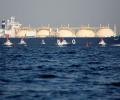
Oil and LNG prices are likely to shoot up if Iran is to block Strait of Hormuz, through which countries like India import crude oil from Saudi Arabia, Iraq and UAE, leading to a spike in inflation, analysts said on the Iran-Israel conflict. The Iran and Israel conflict has escalated over the last few days. Iran first launched drone and rocket attacks on Israel, which retaliated by firing a missile. Crude oil prices have hovered around USD 90 per barrel since the conflict.

The Indian Navy said warships and aircraft were deployed to establish presence, provide a sense of reassurance to the Indian merchant men

The crew of an Egyptian freighter including six Indians, released by Somali pirates on Monday, came under renewed attack by the sea brigands on Wednesday as they sailed in the pirate-infested Somali waters on way to a port in Oman. However, there was no report of any casualty. While the 22-member crew of MV Suez faced the threat of being retaken, the Directorate General of Shipping said the Indian Navy is coordinating with other navies for the safe passage of the ship.

For Navy veterans who watched the huge vessel being towed away by a tug boat, it was an emotional moment as they stood near the Gateway of India, waving at the once 'floating town', aboard which they spent the best years of their career.

A French Navy has rescued eleven Indian sailors from suspected pirates at the mouth of the Gulf of Aden. According to a media release of the Embassy of France in New Delhi, the rescue operation took place on January 18 off the coast of Oman.

Cooperation in key areas of defence, security and counter-terrorism will be an important aspect of Prime Minister Narendra Modi's discussions during his visit to three West Asian countries -- Palestine, the United Arab Emirates and Oman -- starting Friday.

The Indian Navy's flagship carrier, the INS Viraat will be decommissioned on March 6 after serving the nation for 30 glorious years.

Earlier in the day, Bolivia beat Venezuela 3-1 at home and Uruguay and Paraguay drew 0-0 in Montevideo.

He said the US will apply other punitive measures if Tehran does not give up its reported goal of developing nuclear weapons.

'Amid the frequent cries that the defence budget falls short of what is needed, we tend to ignore the reality that any enhancement in the allocation is just not possible, and the armed forces have no option but to operate within this constraint.' 'So, unless deadwood -- especially manpower -- is identified and eliminated, we simply cannot have a modern military of the type that India needs,' says Vice Admiral Premvir Das (retd).
